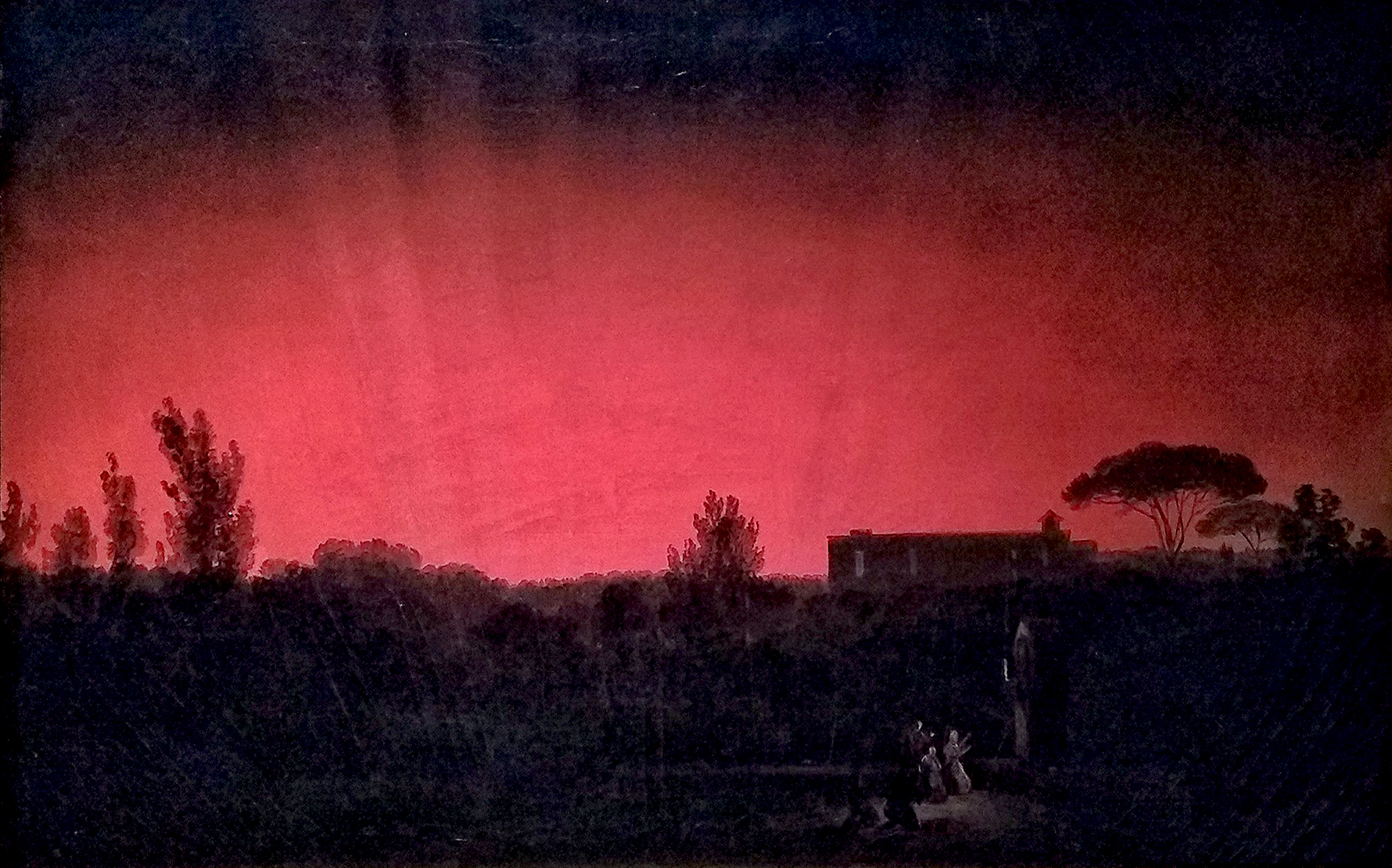
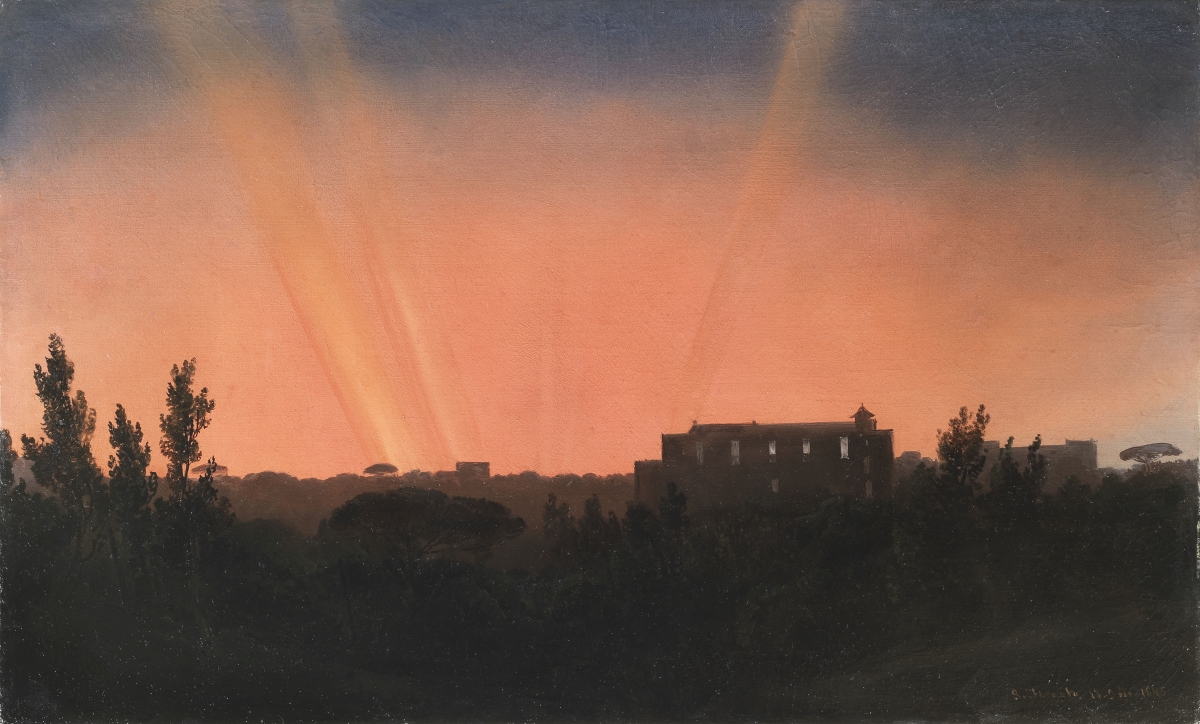
Before leaving Stonyhurst, Secchi witnessed a spectacular Aurora Borealis, which occurred in the night of October 17 – 18, 1848. The phenomenon was so intense and extensive that it was also observed at low latitudes, as demonstrated by the painting depicted here. Salvatore Fergola, one of the main exponents of the Posillipo school, made two different specimens of the painting that probably represent two subsequent phases of the atmospheric phenomenon: the first one with lighter colours and shining rays of light overcasting the countryside northwest of the Capodimonte Observatory; the second one, with bright red tones, shows a group of people gathered in front of a votive shrine in the foreground (Figure 1).
About ten o’clock in the evening, the director of the Observatory of Marina, Mario Patrelli, observed a light that seemed the reverb of a vast fire. The sky appeared as enveloped in a very light red vapor up behind the hills of Capodimonte. “It promptly exhibited a movement and a continuous variability, showing at different points the sky in its natural color or thickening of the purple vapor, time by time: sometimes it was striped with vertical bands,red at different density gradation , or yellow and white interspersed with reddish stripes “.
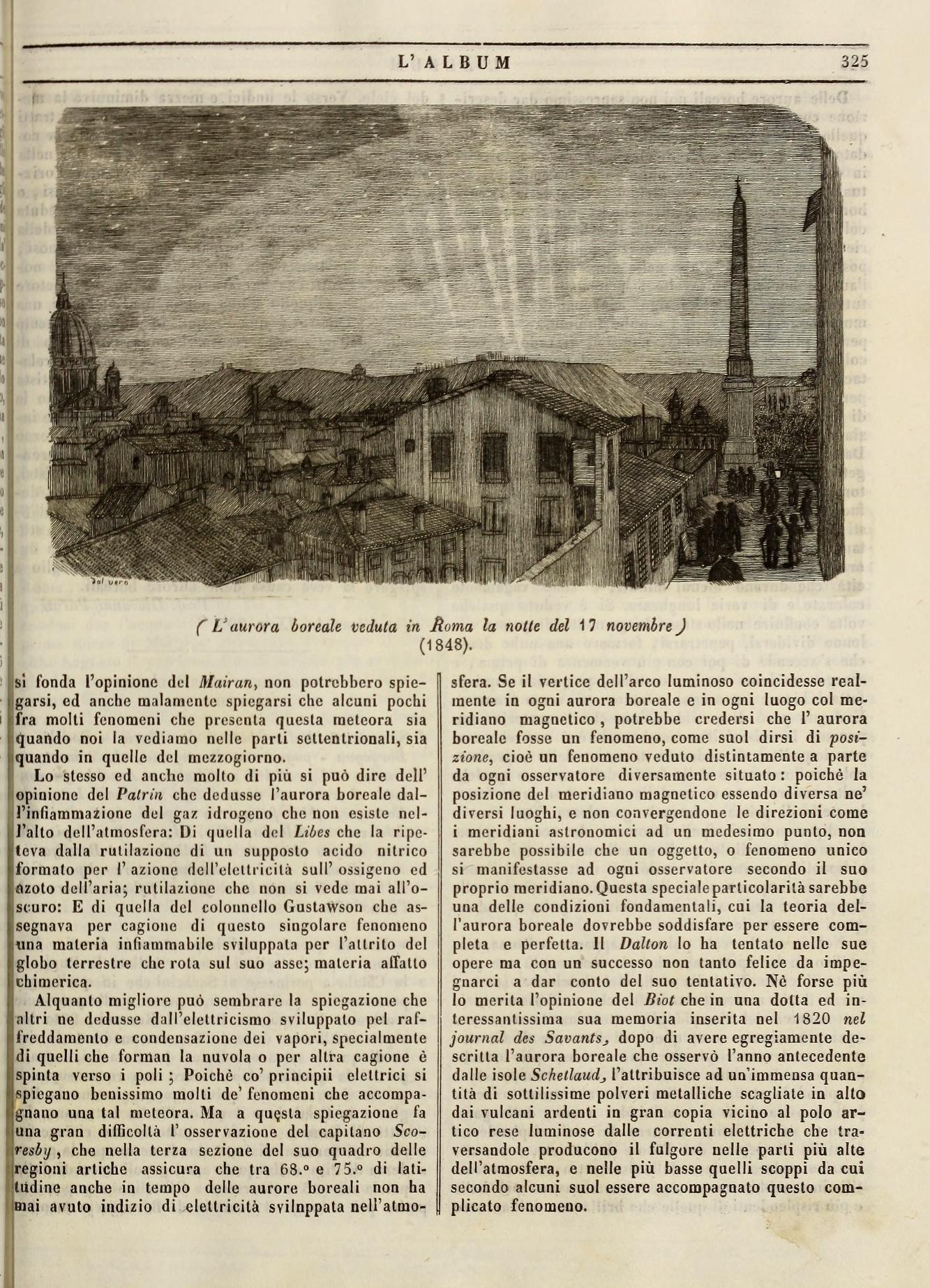
The phenomenon had great echo also in Rome, as evidenced by the article published in the magazine “the album” which describes in detail the astronomical event and the drawing accompanying it made during the event (Figure 2): “A big number of people even still stood by the streets lighten up by a massive festive celebration, remaining ecstatic in the contemplation that brilliant flare [which] lit up the envied sky of Rome. ”
This aurora is an ideal point of connection between the English stay of Secchi and the American one. Indeed, for the second meeting of the American Association for the Advancement of Science, held at Harvard University in Cambridge, Secchi sent the communication: “Aurora borealis” proposing some considerations on the nature of this phenomenon. This study recalled the attention of the famous American physicist Joseph Henry.
The Aurora Borealis of 1848 observed in Naples
"il 17 ottobre 1848 dall’Osservatorio Reale di Capodimonte"
Salvatore Fergola (1796-1874),
1848
oil on canvas, 44 x 72,3 cm
Private collection
Bibliography
G. Parati, "Aurora boreale veduta in Roma nel novembre del 1848", L'album, A. 15, 1849, pp. 324-326; M. Patrelli, "Relazione dell'aurora boreale osservata in Napoli la sera del 17 nov. 1848 dall'Osservatorio Astronomico della R. Marina", Rendiconto delle adunanze e de' lavori dell'Accademia napolitana delle scienze, A. 7, 1848, pp. 383-388; V. Sgarbi, I tesori nascosti: Tino di Camaino, Caravaggio, Gemito, Santarcangelo di Romagna, Maggioli Musei, 2017.