
Angelo Secchi is considered, in full, one of the founding fathers of Astrophysics. The new science, born in the second half of the nineteenth century, was placed in the groove traced by the pioneering studies of spectroscopy of Gustav Kirchhoff and Robert Bunsen, to whom it is the merit of having opened the possibility of knowing the physical and chemical nature of Matter through the analysis of the light using the spectroscope.
Secchi applied spectroscopic methods to the study of the stars and developed an initial spectral classification of the stars that highlighted the link between the energy distribution of the spectrum and the temperature of the stellar atmosphere. He observed at least 4000 stars, ranking them from the hottest to the coldest, according to the following four types:
- I (Alfa Lyrae, Sirio) white-blue stars;
- II (solar, Pollux) yellow stars;
- III (Alfa Orionis, Antares) red and orange stars;
- IV (“Curiose”) red stars with striped spectra
These classes formed the basis of the successive spectral classifications of the stars, from which derived the classifications currently in use. During the twentieth century the studies of Secchi have allowed to develop the methods for the determination of the physical and chemical parameters of the stellar atmospheres that today constitute the observational basis of the models describing the structure and the evolution of the Stars and of stellar systems.
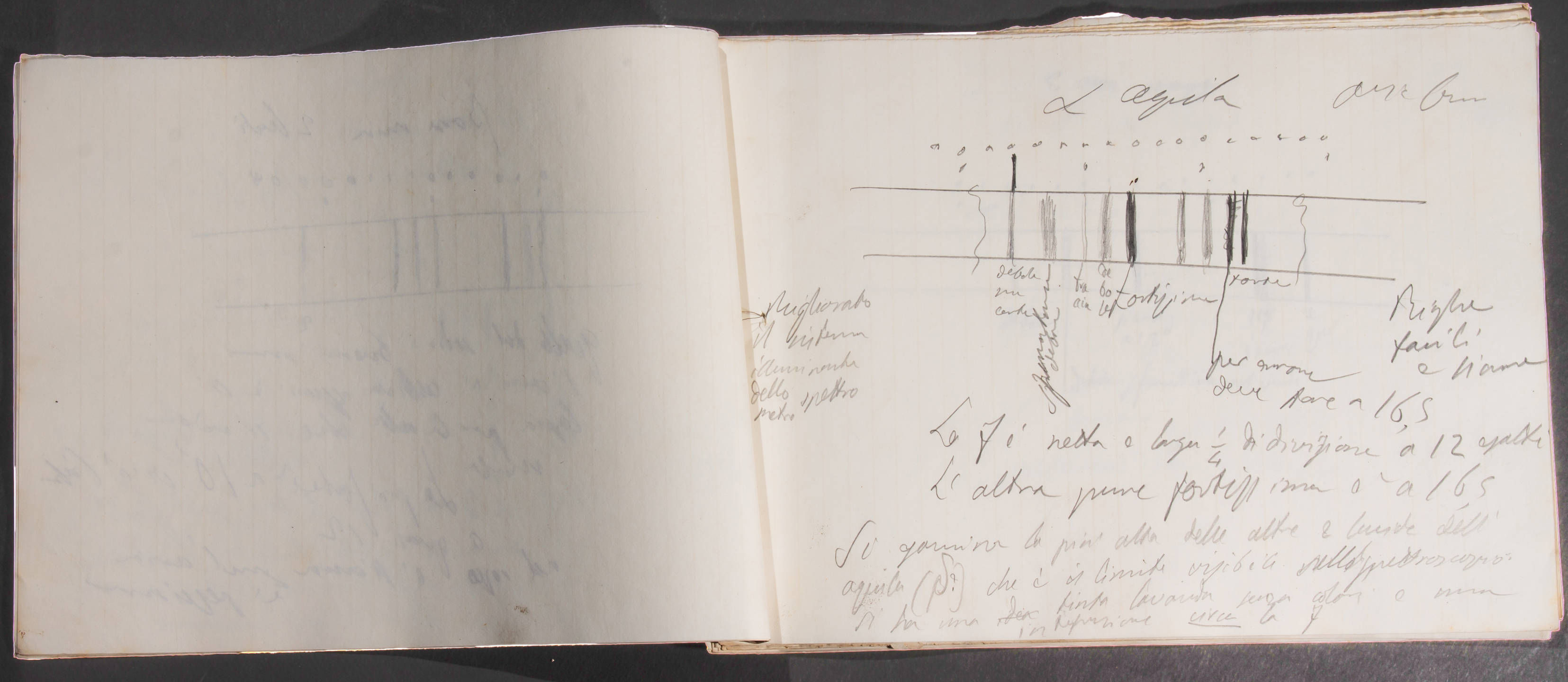
The image reproduced here is taken from the manuscripts describing the various stellar spectra he observed, containing notes and drawings. It shows annotations on the observations of the specter of Altair, the brightest star in the constellation Aquila. Secchi placed her among the stars of the first class, the blue-white ones.
According to the modern spectral classification Altair is a star of type A7 V, characterized by a temperature of 7550 K and a very rapid rotation, which is deduced from the widening of the spectral lines.
After that of the Gregorian University, the second richest archival fund on Secchi is at the Inaf-Rome Astronomical Observatory , and it is relative mainly to scientific papers, drawings and correspondence of Secchi. Other small funds, consisting mostly of letters, are found in the various academies of which he was a member and the institutions (observeratories, above all) with whom he was in contact.